



16-09-2026
09-09-2026
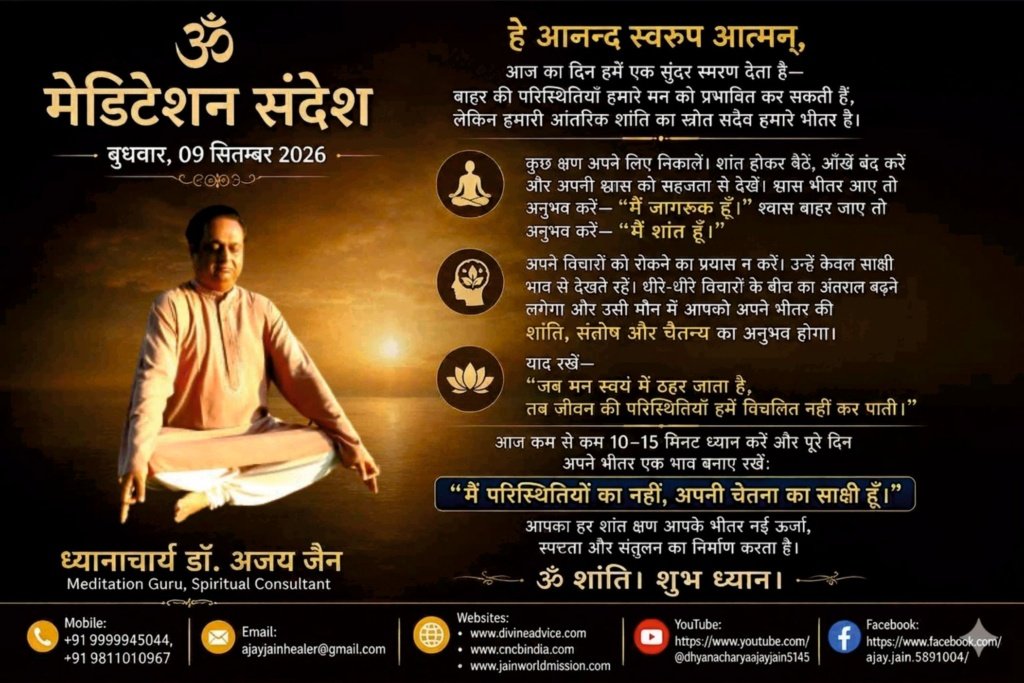
02-09-2026
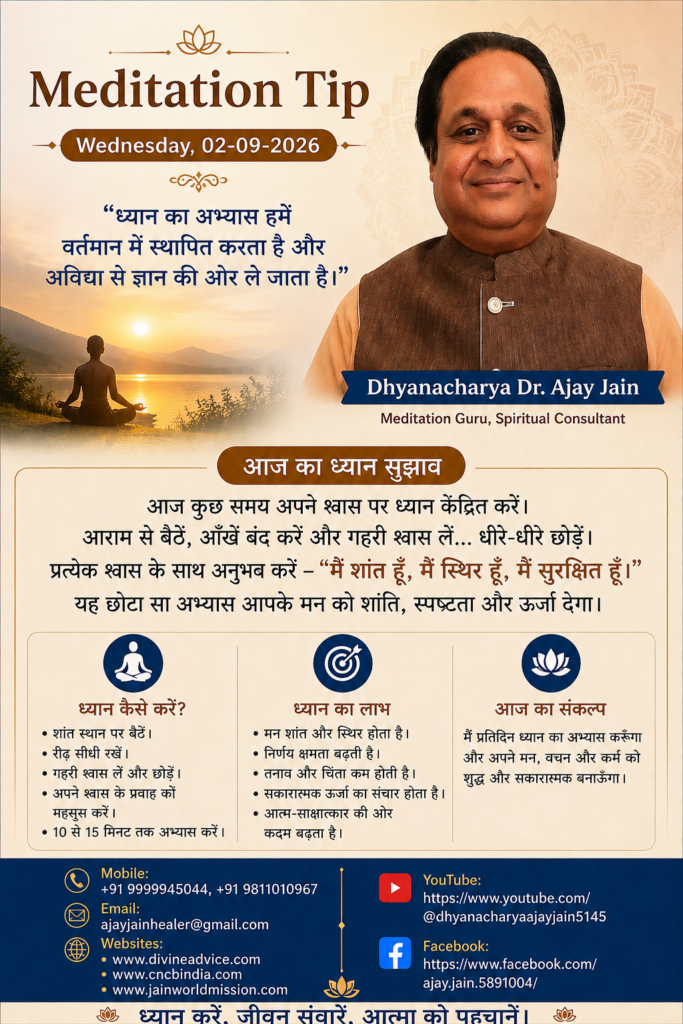
26-08-2026
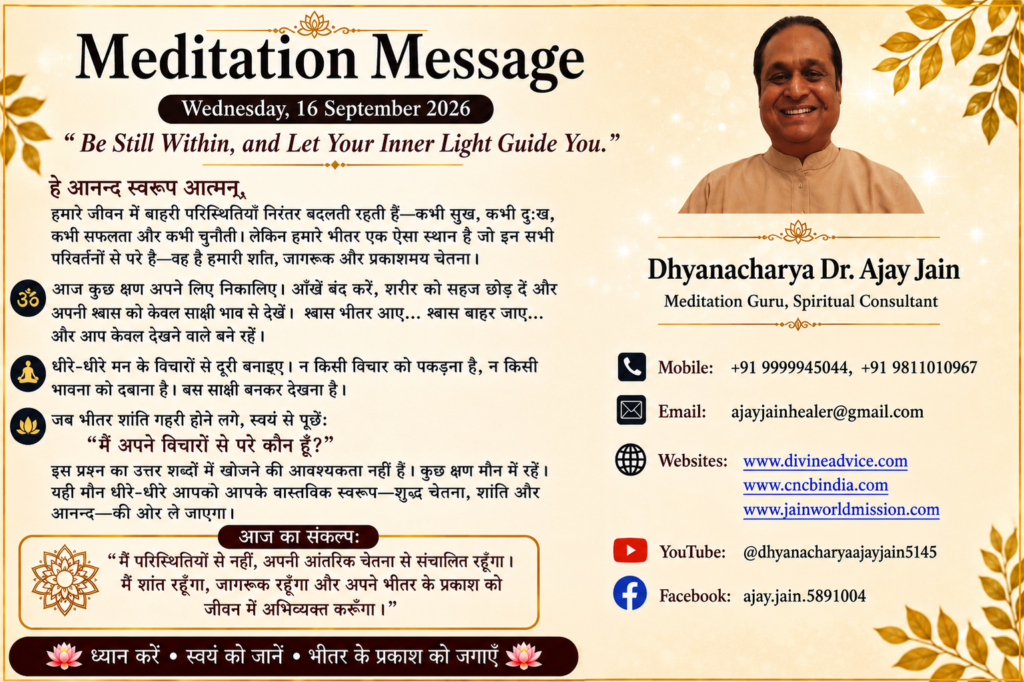
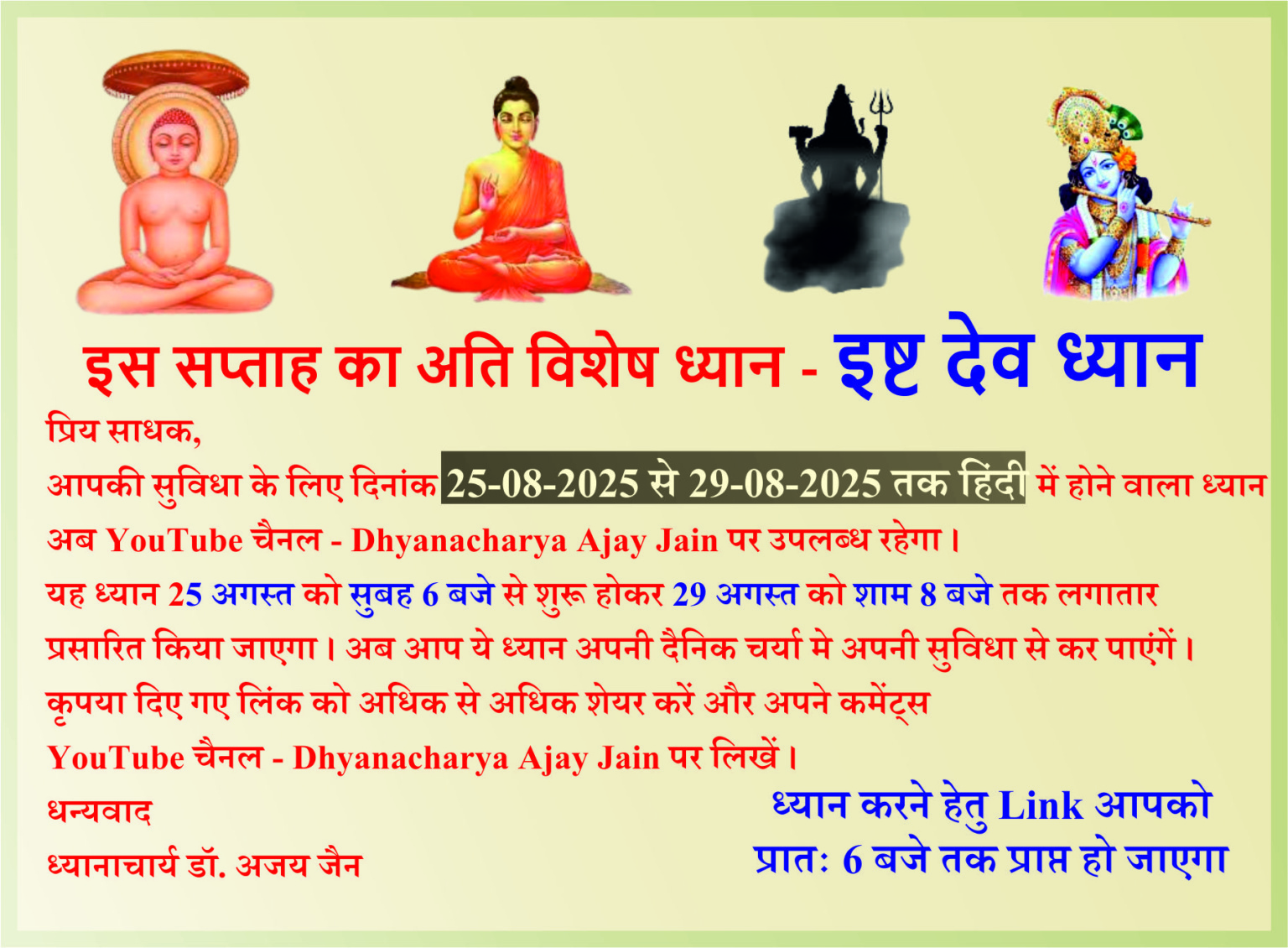
ध्यान संदेश
26-08-2026
ध्यान जीवन को दिशा देता है,
आत्मा को प्रकाश देता है।
ध्यान केवल आँखें बंद करना नहीं है, यह स्वयं के भीतर जागने की प्रक्रिया है। जब हम शांत बैठते हैं, तो हमारा मन बाहरी दौड़-भाग से निकलकर भीतर की निःशब्दता से जुड़ता है।
प्रतिदिन कुछ समय ध्यान को दें। यह समय आपको मानसिक शांति, भावनात्मक संतुलन और आत्मिक शक्ति प्रदान करेगा।
अपने श्वास पर ध्यान दें, प्रत्येक श्वास के साथ सकारात्मक ऊर्जा को अनुभव करें और हर निःश्वास के साथ तनाव को छोड़ें।
याद रखें, ध्यान कोई लक्ष्य नहीं, एक यात्रा है – स्वयं से स्वयं तक की, शांति से आनंद तक की।
आज का संकल्प:
मैं प्रतिदिन ध्यान करूँगा और अपने जीवन में शांति, प्रेम और सकारात्मकता को बढ़ाऊँगा।
“ध्यान से जुड़ें, स्वयं से मिलें और अपने जीवन को आनंदमय बनाएं ।”
ध्यान करें, जीवन संवारें, आत्मा को पहचानें।
Dhyanacharya Dr. Ajay Jain, Spiritual Consultant, Meditation Master Contact Details: Mobile: +91 9999945044, +91 9811010967 Email: ajayjainhealer@gmail.com Websites: www.divineadvice.com www.cncbindia.com www.jainworldmission.com YouTube: https://www.youtube.com/@dhyanacharyaajayjain5145 Facebook: https://www.facebook.com/ajay.jain.5891004/
Meditation Message
26-08-2026
Meditation gives direction to life,
It illuminates the soul.
- Meditation is not just closing your eyes; it is a process of awakening within oneself. When we sit quietly, our mind moves away from the outer hustle and bustle and connects with the silence within.
- Devote some time to meditation every day. This time will provide you with mental peace, emotional balance, and spiritual strength.
- Focus on your breath; experience positive energy with every inhalation and release stress with every exhalation.
- Remember, meditation is not a destination, but a journey—from self to self, from peace to bliss.
Today’s Resolution:
I will meditate every day and enhance peace, love, and positivity in my life.
“Connect with meditation, meet your inner self, and make your life blissful.”
Meditate, transform your life, realize your soul.
21-06-2026
अंतर्यात्रा की पूर्णता: योग से ध्यान की ओर
भारतीय दर्शन और अध्यात्म में योग और ध्यान दो ऐसे स्तंभ हैं जो अक्सर एक-दूसरे के पर्यायवाची मान लिए जाते हैं, परंतु गहनता से देखने पर इनके स्वरूप और अभ्यास में स्पष्ट अंतर दिखाई देता है। ‘योग’ संस्कृत की ‘युज’ धातु से बना है जिसका अर्थ जोड़ना होता है; यह एक अत्यंत व्यापक और समग्र जीवन शैली है जिसमें महर्षि पतंजलि के अष्टांग योग के अनुसार यम, नियम, आसन, प्राणायाम, प्रत्याहार, धारणा, ध्यान और समाधि शामिल हैं। दूसरी ओर, ‘ध्यान’ इसी अष्टांग योग का सातवां अंग है, जो विशेष रूप से मन को एकाग्र, शांत और जागरूक करने की एक मानसिक प्रक्रिया है। जहाँ योग के अंतर्गत शारीरिक मुद्राओं (आसन) और श्वास के नियंत्रण (प्राणायाम) के माध्यम से शरीर, मन और प्राण को साधने का प्रयास किया जाता है और शरीर सक्रिय रहता है, वहीं ध्यान में व्यक्ति पूरी तरह स्थिर और शांत बैठकर अपना पूरा ध्यान किसी बिंदु, विचार, मंत्र या अपनी सांसों पर केंद्रित करता है।
इन दोनों विधाओं के उद्देश्य और स्वास्थ्य लाभ भी अपने स्तर पर भिन्न लेकिन पूरक हैं। योग का प्राथमिक उद्देश्य शरीर को स्वस्थ, लचीला, ऊर्जावान बनाना और रीढ़ की हड्डी को सुदृढ़ करना है, जिससे शारीरिक रोगों से मुक्ति मिलती है। इसके विपरीत, ध्यान का मुख्य केंद्र बिंदु मानसिक स्वास्थ्य है, जो तनाव को कम करने, भावनात्मक स्थिरता लाने, निर्णय क्षमता बढ़ाने और आंतरिक शांति की अनुभूति कराने में सहायक होता है। वास्तव में, योग और ध्यान के बीच का संबंध एक वृक्ष और उसके फल जैसा है; योग शरीर को इस योग्य बनाता है कि वह बिना किसी व्याधि या भटकाव के लंबे समय तक एक स्थान पर बैठ सके, जिससे ध्यान की अवस्था को प्राप्त करना सुगम हो जाता है। अतः योग मनुष्य को बाहर से भीतर की ओर यात्रा कराता है, जबकि ध्यान उसे भीतर की गहराइयों में स्थापित करता है; जीवन में पूर्ण मानसिक और शारीरिक संतुलन पाने के लिए इन दोनों का समन्वय ही सर्वश्रेष्ठ मार्ग है।
मार्गदर्शन सूत्र: योग यदि साधना का आधार है, तो ध्यान उसकी अंतिम निष्पत्ति है। दोनों मिलकर ही अंतर्यात्रा को पूर्णता प्रदान करते हैं।
The Completeness of the Inner Journey: From Yoga to Meditation
In Indian philosophy and spirituality, Yoga and Meditation are two pillars that are often considered synonymous with each other, but upon deeper examination, a clear distinction emerges in their nature and practice.
Yoga is derived from the Sanskrit root word ‘Yuj’, which means to unite or connect; it is a highly comprehensive and holistic lifestyle that, according to Maharishi Patanjali’s Ashtanga Yoga, includes Yama, Niyama, Asana, Pranayama, Pratyahara, Dharana, Dhyana and Samadhi.
On the other hand, Meditation (Dhyana) is the seventh limb of this very Ashtanga Yoga, which is specifically a mental process designed to make the mind focused, calm, and aware. Where Yoga involves active movement to discipline the body, mind and life force through physical postures (Asanas) and breath control (Pranayama), Meditation requires a person to sit completely still and quiet, focusing their entire attention on a specific point, thought, mantra or their own breath. The objectives and health benefits of these two practices are distinct at their respective levels, yet they complement each other beautifully. The primary objective of Yoga is to make the physical body healthy, flexible and energetic while strengthening the spine, thereby providing relief from physical ailments. Conversely, the main focus of Meditation is mental health, aiding in stress reduction, emotional stability, enhanced decision-making and the realization of inner peace.
In reality, the relationship between Yoga and Meditation is like that of a tree and its fruit; Yoga prepares the body to sit in one place for extended periods without any discomfort or distraction, making it easier to attain the state of meditation. Therefore, Yoga takes a person on a journey from the outside inward, while Meditation establishes them deep within their own being; combining both is the ultimate path to achieving complete mental and physical balance in life. As a guiding principle, if Yoga is the foundation of spiritual practice, then Meditation is its ultimate culmination; together, they bring completion to the inner journey.
20-06-2026
अंतरात्मा की पुकार: आध्यात्मिक और सहज ज्ञान के संदर्भ में ध्यान की शक्ति को जगाना — ध्यानाचार्य डॉ. अजय जैन
आज की इस अत्यधिक व्यस्त और तेज़ रफ़्तार आधुनिक दुनिया में, आपका ध्यान लगातार बाहर की ओर खिंचता रहता है । आप हर समय नोटिफिकेशन्स, डेडलाइन्स और सामाजिक अपेक्षाओं से घिरे रहते हैं । इसके बावजूद, सबसे गहन यात्रा जो आप कभी कर सकते हैं, वह महाद्वीपों के पार की नहीं, बल्कि अपने भीतर की है ।
जब आप रोज़मर्रा की ज़िंदगी के इस शोर-शराबे को हटा देते हैं, तब आपका सामना मानव चेतना के एक विशाल, अछूते संसार से होता है । अक्सर ध्यान को उसके व्यावहारिक और वैज्ञानिक रूप से प्रमाणित स्वास्थ्य लाभों—जैसे तनाव कम करने, रक्तचाप को नियंत्रित करने और एकाग्रता को बढ़ाने के लिए सराहा जाता है । हालांकि, इसकी वास्तविक और प्राचीन जड़ें कहीं अधिक गहरी हैं । अपने मूल रूप में, ध्यान आध्यात्मिक जागृति और तीव्र सहज ज्ञान (Intuition) का अंतिम द्वार है ।
आध्यात्मिक परिवर्तन: अलगाव से अंतर्संबंध तक
आध्यात्मिकता का मतलब केवल किसी विशेष धर्म का पालन करना नहीं है; बल्कि, यह खुद से परे किसी बड़ी शक्ति या चेतना से जुड़ाव की एक अत्यंत व्यक्तिगत अनुभूति है । यह इस बात का अहसास है कि आप केवल अलग-अलग जैविक मशीनें नहीं हैं, बल्कि एक ब्रह्मांडीय चेतना की ही अभिव्यक्ति हैं ।
सामान्य जीवन में, आपका मन ‘अहंकार’ (Ego) के नियंत्रण में रहता है—वह आंतरिक कथावाचक जो अतीत के पछतावे, भविष्य की चिंताओं, बंधनों और अलगाव (“मैं बनाम दुनिया”) में उलझा रहता है । ध्यान इस अहंकार के खोल को धीरे-धीरे पिघलाने का काम करता है ।
‘करने’ से ‘होने’ की ओर संक्रमण (The Transition from Doing to Being)
आपके जीवन का अधिकांश हिस्सा लगातार कुछ न कुछ “करने” में बीत जाता है । ध्यान आपसे पूर्ण रूप से “होने” की मांग करता है । बिना किसी निर्णय के मौन में बैठकर और अपने विचारों को केवल देखकर, आप अपनी पहचान को विचारों से हटाकर उस शून्य या स्थान पर ले जाते हैं जहाँ विचार उत्पन्न होते हैं । अब आप क्रोध, चिंता या महत्वाकांक्षा नहीं रह जाते; बल्कि आप उन्हें देखने वाले एक शांत और अविचल साक्षी (Witness) बन जाते हैं ।
अलगाव के भ्रम का मिटना
जैसे-जैसे मन गहरे ध्यान की अवस्था में स्थिर होता है, स्वयं की सीमाएँ धुंधली होने लगती हैं । दुनिया भर की आध्यात्मिक परंपराएँ—चाहे वह प्राचीन भारत का वैदिक विज्ञान हो, महावीर की चेतना हो या सूफी रहस्यवाद—इसे एकात्मता या समाधि की अवस्था कहती हैं । आप सहज रूप से यह समझने लगते हैं कि आप समुद्र में एक बूंद नहीं हैं, बल्कि एक ही बूंद में समाया पूरा समुद्र हैं ।
सहज ज्ञान की चिंगारी: उच्च स्वरूप से जुड़ना (Tuning In to the Higher Self)
सहज ज्ञान (Intuition) को अक्सर “छठी इंद्री”, आंतरिक आवाज (Gut Feeling) या बिना सोचे-समझे अचानक मिलने वाली अंतर्दृष्टि कहा जाता है । यह वह अचानक होने वाला अचूक बोध है जो आपको सही निर्णय लेने की ओर ले जाता है, खतरों से आगाह करता है या किसी बेहतरीन रचनात्मक विचार को जन्म देता है ।
यह सहज ज्ञान कहाँ से आता है? यह मन की अवचेतन (Subconscious) और अतिचेतन (Superconscious) परतों से उत्पन्न होता है—स्वयं का वह क्षेत्र जो आपके दैनिक तार्किक और विश्लेषणात्मक विचारों के शोर में पूरी तरह से दब जाता है ।
सामान्य जागरूकता में, आप मुख्य रूप से अशांत मन (The Noisy Mind) के भीतर काम करते हैं—एक ऐसी उथल-पुथल वाली स्थिति जो तार्किक विचारों, दैनिक तनाव, अंतहीन कार्यों की सूची और अहंकार की बेचैन आवाज़ के निरंतर प्रवाह से घिरी रहती है । यह आंतरिक कोलाहल आपकी गहरी चेतना को दबा देता है ।
ध्यान के अभ्यास से यह मानसिक बकबक धीरे-धीरे शांत हो जाती है, जिससे चेतना शांत मन (The Still Mind) में परिवर्तित हो जाती है । गहरे मौन की इस अवस्था में, एक विशाल आंतरिक शून्यता का निर्माण होता है, जो मानसिक कचरे को पूरी तरह साफ कर देता है ।
एक बार जब मन पूरी तरह शांत हो जाता है, तो यह सहज आवाज़ (The Intuitive Voice) को स्वाभाविक रूप से उभरने का मार्ग देता है । तार्किक विचारों के शोर से मुक्त होकर, यह आवाज़ अत्यंत कोमलता और स्पष्टता से प्रकट होती है, जो आपको सूक्ष्म अंतःप्रेरणा, अचानक कौंधने वाले रचनात्मक विचारों और आपके भीतर छिपे मूल ज्ञान से जोड़ती है ।
अपने आंतरिक रडार को परिष्कृत करना
आंतरिक शोर (Static) को साफ करना
कल्पना कीजिए कि आपका मन एक रेडियो रिसीवर है । सहज ज्ञान एक विशिष्ट फ्रीक्वेंसी पर प्रसारित होने वाली एक मधुर और सुंदर धुन है । लेकिन, यदि आपका रेडियो चिंता, योजना और मानसिक बकबक के शोर से फुल वॉल्यूम में बज रहा है, तो आप उस संगीत को कभी नहीं सुन पाएंगे । ध्यान इस आंतरिक शोर को धीमा कर देता है, जिससे सहज ज्ञान का स्पष्ट और शुद्ध सिग्नल आपको मिलने लगता है ।
ब्रेनवेव अवस्थाओं का बदलना
न्यूरोलॉजिकल शोध से पता चलता है कि ध्यान आपके मस्तिष्क की तरंगों (Brainwaves) के पैटर्न को बदल देता है । सामान्य जाग्रत अवस्था में, आप बीटा तरंगों (सक्रिय, तार्किक सोच) में काम करते हैं । जैसे ही आप ध्यान करते हैं, आप अल्फा तरंगों (शारीरिक और मानसिक शिथिलता) और अंततः थिटा तरंगों (गहरे ध्यान और स्वप्न की अवस्था) में चले जाते हैं । थिटा तरंगें ही उच्च सहज ज्ञान, गहन रचनात्मकता और आध्यात्मिक ज्ञान का वास्तविक क्षेत्र हैं ।
अहंकार बनाम सहज ज्ञान की पहचान
जीवन की सबसे बड़ी चुनौतियों में से एक यह पहचानना है कि कोई “आंतरिक आवाज” वास्तव में आपका सहज ज्ञान है या सिर्फ आपका छुपा हुआ डर । ध्यान आपको अपने आंतरिक परिदृश्य का एक विशेषज्ञ खोजी बनना सिखाता है ।
अहंकार की आवाज़ आमतौर पर तेज़, व्याकुल, डरी हुई और बहुत अधिक तर्क-वितर्क करने वाली होती है (जैसे, “यदि तुमने ऐसा नहीं किया, तो सब कुछ बर्बाद हो जाएगा, तुम्हें अपनी रक्षा करनी ही होगी!”) ।
सहज ज्ञान की आवाज़ इसके विपरीत होती है । यह शांत, निष्पक्ष, तटस्थ होती है और एक पूर्ण और स्पष्ट सत्य की तरह अचानक भीतर उतरती है (जैसे, “यहाँ से हट जाओ” या “यही सही मार्ग है”) ।ध्यान आपको वह शांत स्थान देता है जिसकी सहायता से आप इन दोनों के बीच का अंतर समझ पाते हैं ।
आध्यात्मिक और सहज स्वरूप को जगाना: एक सरल अभ्यास
ध्यान के इन गहरे आयामों को खोलने के लिए आपको बीस साल तक किसी हिमालय की गुफा में जाने की आवश्यकता नहीं है । अभ्यास की निरंतरता उसकी तीव्रता से कहीं अधिक शक्तिशाली है ।
एक पवित्र स्थान बनाएं: अपने घर में ध्यान के अभ्यास के लिए एक छोटा, शांत कोना समर्पित करें । एक दीपक या अगरबत्ती जलाएं ताकि आपके अवचेतन मन को यह संकेत मिले कि अब बाहरी दुनिया से आंतरिक दुनिया की ओर जाने का समय हो गया है ।
श्वास या मंत्र पर ध्यान केंद्रित करें: श्वास को एक एंकर (सहारे) के रूप में उपयोग करें । इसके अतिरिक्त, आप अपने तार्किक मन को एकाग्र करने के लिए किसी पवित्र ध्वनि या मंत्र (जैसे ॐ या सोऽहम्) का उपयोग कर सकते हैं ।
परिणाम की इच्छा का त्याग करें: किसी आध्यात्मिक दृश्य को देखने या तुरंत कोई सहज उत्तर पाने के व्याकुल लक्ष्य के साथ ध्यान में न बैठें । वह व्याकुलता ही अपने आप में एक नया शोर पैदा करती है । पूर्ण समर्पण के भाव से बैठें । जो कुछ भी भीतर से उभरना चाहता है, उसे सहजता से आने दें ।
ध्यान के बाद का मौन (The After-Quiet): जब आपके ध्यान का समय पूरा हो जाए, तो तुरंत उठकर अपना फोन न देखें । कम से कम दो मिनट तक उस शांति की गूंज में बैठें । ध्यान के बाद का यही मौन वह समय होता है जब सहज ज्ञान आपके भीतर धीरे से फुसफुसाता है ।
ध्यान अंततः पूर्ण आत्म-प्रेम और एक आध्यात्मिक क्रांति का कार्य है । शांत बैठने का चुनाव करके, आप यह घोषणा करते हैं कि आपकी आंतरिक शांति किसी भी बाहरी प्रशंसा या मान्यता से कहीं अधिक मूल्यवान है ।
जैसे-जैसे आपका अभ्यास गहरा होगा, आप पाएंगे कि अब आप इस अराजक ब्रह्मांड में खुद को अकेला या भटका हुआ महसूस नहीं करते । इसके बजाय, आप एक गहरे आध्यात्मिक विश्वास से जुड़े रहेंगे और एक ऐसे अचूक आंतरिक कम्पास द्वारा निर्देशित होंगे जो आपको कभी गलत रास्ते पर नहीं ले जाएगा । आप बाहर जवाब खोजना बंद कर देते हैं क्योंकि अंततः आपने अपने भीतर छिपी दिव्यता को सुनना सीख लिया है ।
The Whispering Soul: Unlocking the Power of Meditation in Spiritual and Intuitive Contexts – Dhyanacharya Dr. Ajay Jain
In hyper-connected, fast-paced modern world, your attention is constantly pulled outward. You are bombarded with notifications, deadlines and societal expectations. Yet, the most profound journey you can ever take is not across continents, but inward.
When you strip away the noise of daily life, you encounter the vast, untapped landscape of human consciousness. Meditation is often celebrated for its practical, scientifically proven health benefits—reducing stress, lowering blood pressure and sharpening focus. However, it’s true, ancient origins lie far deeper. At its core, meditation is the ultimate portal to spiritual awakening and heightened intuition.
The Spiritual Crucible: From Isolation to Interconnection
Spirituality is not necessarily about adhering to a specific religion; rather, it is the deeply personal recognition of a connection to something larger than oneself. It is the realization that you are not just isolated biological machines, but expressions of a universal consciousness.
In ordinary life, your mind is dominated by the ego—that internal narrator obsessed with past regrets, future anxieties, labels and separation (“me versus the world”). Meditation acts as a gentle solvent for this egoic shell.
The Transition from Doing to Being
Most of our lives are spent in a state of constant “doing.” Meditation demands absolute “being.” By sitting in stillness and observing your thoughts without judgment, you shift your identity from the thoughts themselves to the space in which thoughts occur. You are no longer the anger, the worry or the ambition; you are the silent, unshakeable witness observing them.
Dissolving the Illusion of Separation
As the mind settles into deep meditative states, the boundaries of the self begin to soften. Spiritual traditions across the globe—from the Vedic sciences of ancient India to Mahaveer’s consciousness and Sufi mysticism—describe this as a state of oneness or Samadhi. You begin to intuitively understand that you are not a drop in the ocean, but the entire ocean in a single drop.
The Intuitive Spark: Tuning In to the Higher Self
Intuition is often called the “sixth sense,” a gut feeling or a flash of unearned insight. It is that sudden, inexplicable knowing that guides toward the right decision, warns you of danger or sparks a brilliant creative idea.
Where does intuition come from? It originates in the subconscious and superconscious layers of the mind—the realms of the self that are completely drowned out by the megaphone of our daily analytical thoughts.
In ordinary awareness, you primarily operate within The Noisy Mind—a turbulent state dominated by a loud and constant stream of analytical thoughts, daily stress, endless to-do lists and the anxious narrative of the ego voice. This internal static effectively drowns out your deeper awareness.
Through the practice of meditation, this mental chatter is progressively silenced, transitioning consciousness into The Still Mind. In this state of profound stillness, a vast space of inner silence is created, clearing away the cognitive clutter.
Once the mind becomes entirely calm, it allows The Intuitive Voice to naturally emerge. Free from the distraction of analytical noise, this voice manifests softly and clearly, offering subtle gut feelings, sudden creative flashes and an anchor to your inherent wisdom.
Clearing the Internal Static
Imagine your mind is a radio receiver. Intuition is a subtle, beautiful melody being broadcast on a specific frequency. However, if your radio is blasting the static of worry, planning and mental chatter, you will never hear the music. Meditation lowers the volume of the static, allowing the clear, crisp signal of intuition to come through.
Shifting Brainwave States
Neurological research shows that meditation alters your brainwave patterns. In regular waking life, you operate in Beta waves (active, analytical thinking). As you meditate, you slide into Alpha waves (relaxed awareness) and eventually into Theta waves (deep meditation and dreaming). Theta waves are the exact playground of high intuition, profound creativity and spiritual epiphanies.
Discerning the Ego vs. Intuition
One of the hardest challenges in life is figuring out if a “gut feeling” is true intuition or just hidden fear. Meditation trains you to become an expert tracker of your own inner landscape.
The Ego’s Voice is usually loud, frantic, anxious and highly conversational (e.g., “If you don’t do this, everything will ruin, you must protect yourself!”).
Intuition’s Voice is entirely different. It is quiet, neutral, objective and drops in like a sudden absolute certainty (e.g., “Walk away” or “This is the path”). Meditation gives you the quiet space required to tell the difference.
Cultivating the Spiritual and Intuitive Self: A Simple Practice
To unlock these deeper dimensions of meditation, you don’t need to retreat to a Himalayan cave for twenty years. Consistency is far more powerful than intensity.
Create a Sacred Space: Dedicate a small, quiet corner of your home for your practice. Light a candle or incense to signal to your subconscious that it is time to transition from the external world to the internal world.
Focus on the Breath or a Mantra: Use the breath as an anchor. Alternatively, use a sacred sound or mantra (like Aum or Soham) to give your analytical mind a singular point of focus.
Surrender the Outcome: Do not meditate with the desperate goal of seeing a spiritual vision or getting an intuitive answer. The desperation itself creates static. Sit with the intention of pure surrender. Let go, and let whatever needs to surface, surface.
The “After-Quiet”: When your timer goes off, do not immediately jump up to check your phone. Sit in the echo of the silence for two minutes. This “after-quiet” is precisely when intuition loves to whisper.
Meditation is ultimately an act of radical self-love and spiritual rebellion. By choosing to sit still, you are declaring that your internal peace is more valuable than external validation.
As you deepen your practice, you will find that you no longer feel isolated or adrift in a chaotic universe. Instead, you will feel anchored by a profound spiritual trust and guided by a sharp, inner compass that never steers you wrong. You stop searching for answers outside because you have finally learned how to listen to the divinity within.
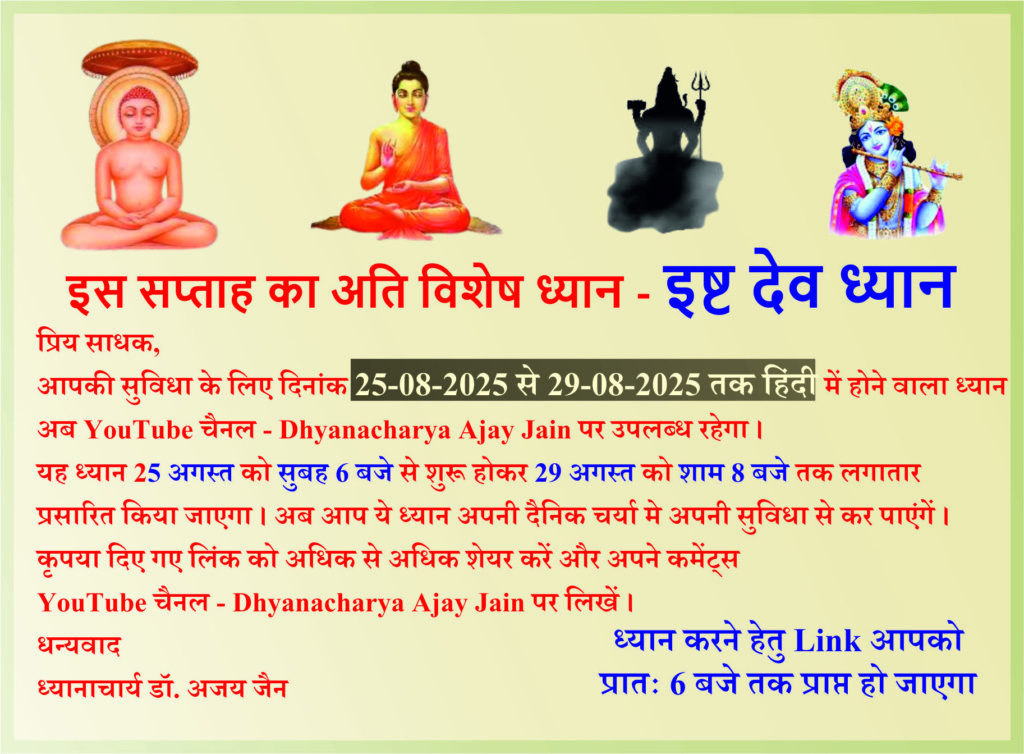
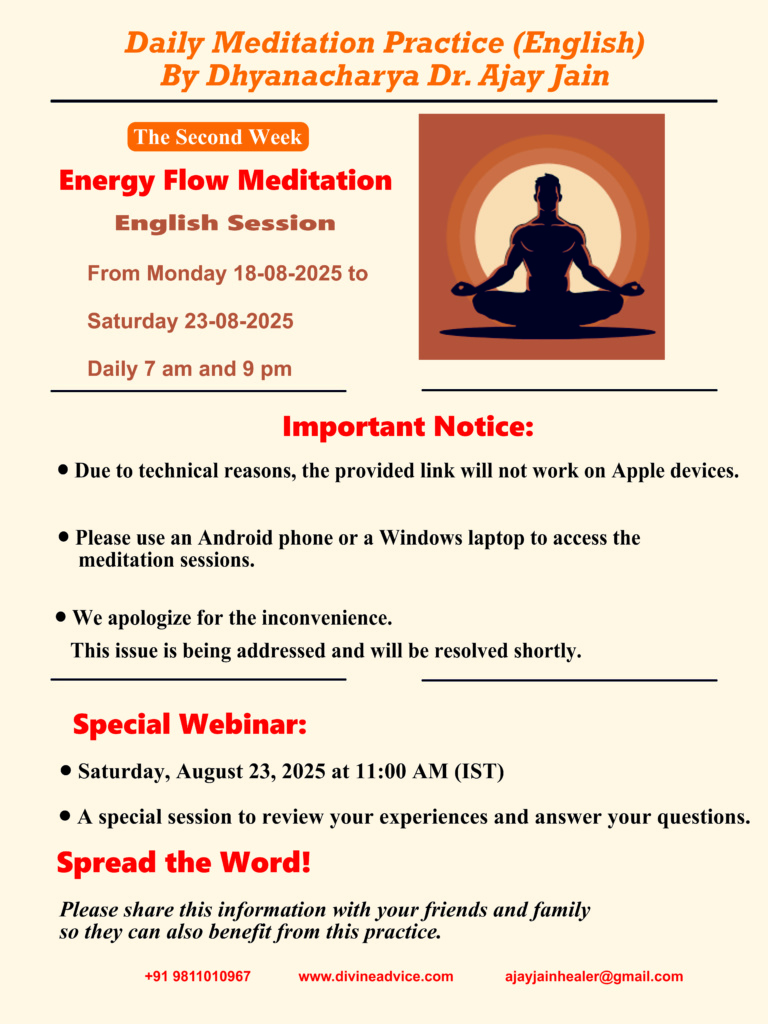
MEDITATION - A PROCESS OF SELF PURIFICATION
Dhyanacharya Dr. Ajay Jain is a Meditation Guru, a guide to many helping them learn various meditation techniques and practices.
According to Dhyanacharya Ajay Jain, Meditation is a continuous process of self-purification. Meditation is a process to remain with self and exploring one’s true, real and spiritual identity through concentration and oneness of body, mind and soul. The process of self purification can be achieved by exploring the deepest of self and there from starting the journey to the spiritual world.
Meditation is gaining popularity day by day as it results in release of stress and peace of mind. It is now established that practicing meditation can help in cure of almost all kind of physical and mental deceases.
Dhyanacharya is associated with many Indian and foreign institutions and organizations and guiding them achieve their goals.
In the process of pealing an onion we can very well see that till the end only onion is left and the smallest left over part is purest form of onion and can result in beginning of a new process. The process of self purification can be achieved same way as we have to see the deepest of self and there from we have to start our journey to the spiritual world.
Meditation is gaining popularity day by day as it results in release of stress and peace of mind is achieved.
Meditation can be practiced any where at any time. It is important that it should be practiced under the guidance of expert teacher.
Dhyanacharya Dr. Ajay Jain’s Divine Service helps all seekers achieve desired results by making them meditate the way that suits them best.
Lorem ipsum dolor sit amet, consectetur adipiscing elit. Ut elit tellus, luctus nec ullamcorper mattis, pulvinar dapibus leo.
Dhyanacharya Dr. Ajay Jain is a Meditation Guru, a guide to many helping them learn various meditation techniques and practices.
According to Dhyanacharya Ajay Jain, Meditation is a continuous process of self-purification. Meditation is a process to remain with self and exploring one’s true, real and spiritual identity through concentration and oneness of body, mind and soul. The process of self purification can be achieved by exploring the deepest of self and there from starting the journey to the spiritual world.
Meditation is gaining popularity day by day as it results in release of stress and peace of mind. It is now established that practicing meditation can help in cure of almost all kind of physical and mental deceases.
Dhyanacharya is associated with many Indian and foreign institutions and organizations and guiding them achieve their goals.
In the process of pealing an onion we can very well see that till the end only onion is left and the smallest left over part is purest form of onion and can result in beginning of a new process. The process of self purification can be achieved same way as we have to see the deepest of self and there from we have to start our journey to the spiritual world.
Meditation is gaining popularity day by day as it results in release of stress and peace of mind is achieved.
Meditation can be practiced any where at any time. It is important that it should be practiced under the guidance of expert teacher.
Dhyanacharya Dr. Ajay Jain’s Divine Service helps all seekers achieve desired results by making them meditate the way that suits them best.